Archive for the ‘public affairs’ Category

The Emperor’s New Clothes

“But he hasn’t got anything on” a little child said (Hans Christian Andersen)

 Three measures taken by the central government in recent years do not seem to be yielding dividends, at least in the short term. Demonetisation started off with the promise of unearthing black money, moved on to promising a cashless nirvana and has finally only succeeded in damaging growth prospects. The Goods and Services Tax (GST), after so many years in the making, was rushed through in a matter of months with inadequate software readiness and with poor education of the masses of small retailers and traders who, willy nilly, had to move overnight to online systems for which they were totally unprepared. The informal sector has been particularly hard hit by the speed of GST imposition. Implementation of Aadhaar was pushed through as a money bill. It is still facing civil society resistance in the Supreme Court, especially because of the stubborn bureaucratic insistence on treating it as a panacea for all of India’s ills, including tax leakages and terrorism, instead of first focusing on streamlining the process of beneficiary entitlements.

What has marked all these three “initiatives” has been the attempt by the political executive to display its so-called dynamism, consequences be damned. What has been even more noteworthy is the failure of the civil service, especially at the highest levels, to caution its political masters in rushing through with measures that affect the lives of large masses of people. Like the courtiers in Andersen’s fable, they are effusive in rushing to extol these policies, without sparing a thought for harsh realities. The same could be said for the inordinate haste of BJP state governments in pushing through legislation banning the sale and consumption of beef, which has jeopardised the livelihoods of large numbers, especially from the Muslim and Dalit communities, apart from rendering them vulnerable to vicious attacks by vigilante groups.

And now, the government has dropped a bombshell — it seems to want to tinker in a major way with the manner in which senior civil servants are allotted services after selection and the states to be allotted to those selected for the All-India Services. The only document available in the public domain is a letter from a Joint Secretary in the central government’s Department of Personnel to the Deputy Director General in the Department of Telecommunications. Ordinarily, such a letter would not even be deemed worthy of notice. What has set the cat among the pigeons is the mention in the letter that the measure is sought to be implemented from later this year, which means that the batch just selected (2019 batch) will serve as the guinea pigs. As a member of the 1980 civil service batch which served as guinea pigs for the last effort at civil service recruitment process reform, courtesy the Kothari Committee report, I am bemused that views of departments are being sought without any background paper or report serving as the basis for the thought process. It almost seems as though (à la demonetisation) the decision has already been taken and a perfunctory consultation process is being gone through before orders are issued.

Many of my colleagues in the civil services (all retired) have expressed themselves forcefully on this issue. While we are almost unanimous in our view that the civil service recruitment system is in need of reform, our apprehensions stem from the rather flimsy methodology suggested for the service/state cadre allocation, which would strike at the very roots of the concept of a competent, impartial civil service. The faculty at the Lal Bahadur Shastri National Academy of Administration, Mussoorie and at other institutes, where foundation courses are conducted, are hardly equipped to critically assess the capabilities of officers for deciding their suitability for different services. There are likely to be three deleterious implications if the proposed course of action is gone through in haste, without addressing fundamental issues of evolving a sound selection process.

Cronyism is the probable first evil that has to be factored in. India is still a country where regional, language and caste factors exercise a strong pull. Without disparaging my erstwhile colleagues from the northern states, it is a fact that, barring the Rajiv Gandhi era, there was a predominance of three or four states, especially Uttar Pradesh, in the senior echelons of administrative decision making at the centre, in the first fifty years after independence. While this phenomenon may be partly attributed to the reluctance of officers from the southern and western states to go on central deputation, it is also a fact that positions in key economic ministries were occupied by officers from the northern states or those who kept in close touch with the levers of power in Delhi. That the fulcrum has now moved to Gujarat is no cause for comfort: it only proves that bureaucrats most in sync with the political dispensation of the day at the centre rule the roost. But, at least, central deputation has finite time limits, till repatriation or retirement ends the bureaucrat’s tenure. The mind boggles, however, at the thought that a protégé can be given a lifetime job guarantee by a favourably disposed godparent at the time of service selection.

Corruption will inevitably follow any such non-transparent process, following Lord Acton’s dictum that “…absolute power corrupts absolutely”. In an ocean of corrupt State Public Service Commissions, the Union Public Service Commission maintained its reputation for integrity in the selection process for over six decades. While one may quibble over the manner of selection — bookish, elitist, etc. — there has never been a question of individuals (or coaching classes) using the lure of lucre to manipulate the selection process. I shudder at the prospect of the future of the country’s administration being subject to the possibility of temptations being dangled before faculty in training academies, who are called on to adjudicate between the relative merits of different candidates who qualify for the civil services, especially when one witnesses the debasement of so many institutions by the pernicious influence of money power.

Politicisation of the civil services will be the obvious corollary of any post-selection evaluation mechanism. The candidate who is smart enough to qualify for the foundation course will also be smart enough to realise that s(he) can use political strings to swing the desired service/state in his/her direction. The reign of different political dispensations every five years will only add masala to the selection process. And, heavens forbid, if the same party continues to rule at the centre for two or three decades, nothing stops it from packing the civil services with officers loyal to its ideology, fulfilling the Emergency dream of a “committed bureaucracy”. In a federal set up, where parties opposed to each other may be in power at the centre and in the states, nothing short of anarchy will reign when civil servants of the All-India Services assigned to different states are looked at with suspicion by state governments. We have already had a foretaste of this in Delhi because of no love lost between the Delhi government and the central government.

Merit is likely to be a casualty of the proposed changes. But the issue of choice also rises. Young Indians spend the best part of their productive years attempting to seize the holy grail of the civil services. Now, when the grail seems to be within reach, it could be snatched away by the whims of a few instructors or the machinations of colleagues, aided and abetted by unscrupulous elements. When certain services continue to exercise an allurement for prospective civil servants similar to that of the songs of the Sirens for sailors in Greek mythology, introducing an element of uncertainty for a further period of six months to one year after selection could lead to one of two consequences: (a) it could discourage bright young women and men from seeking to join the civil services, or (b) more damagingly, it could encourage the entry of elements who seek to obtain their desired service/state through any means, mostly foul. If you doubt me, just see the type of candidates who are standing for elections to legislatures and Parliament. Gresham’s law of the civil services will then operate with a vengeance.

Let me hasten to add that I, and most of my retired friends in the civil services, are strongly in favour of reforms in the processes of selection to the civil services as well as subsequent career advancement. We recognise that there has been considerable heartburning over the fact that a single examination decides the future life trajectory of an individual. You could argue that so does an IIT or IIM selection process, but then these are not lifetime guarantees. The IIT/IIM graduate still has to compete with others for entry into a particular line of employment. At the same time, given that there is so much hype to get a “prestigious” civil service job, the selection process has to be insulated from pressures and influences. In an earlier blog (Reshaping India’s bureaucracy – a blueprint for action), I had proposed wide ranging changes in the structure of the civil services, including the abolition of the All-India Services and making all appointments contractual, to meet the administrative challenges of the coming decades. While I am sure that there will be plenty of views on (and criticism of) my suggestions, I strongly feel that cosmetic changes are no solution to a bureaucratic system that is perceived by the mass of the people of India as unresponsive, lethargic and tyrannical. It is possible that some variant of what I have proposed could be devised, with implementation in stages. But unless the issue is addressed at all levels of government — central, state and local — and efficiency and accountability are introduced in governance, the Indian public will continue to be shortchanged in service delivery and India’s long-term growth and development prospects will be affected.

The need of the hour is a close, hard look at what is wrong with our governance systems and how to improve these. Merely toying with service allotment or state allocation is no solution: if anything, these will worsen the situation and lay the government of the day open to the charge of changing the system to suit its political requirements. It would indeed be ironical if a government that swears by Sardar Patel were to demolish the edifice of the civil services built up by him, without developing a viable long-term alternative. Were this to occur, we can only take refuge in the words of the late Jayaprakash Narayan “विनाशकालेविपरीतबुद्धि”(when one’s doom approaches, one’s intelligence works perversely).

No Shades Of Grey for India

I am not, as you might think, advocating the banning of the erotic book and film which have titles similar to the headline of this blog. But I am getting increasingly convinced that operating in grey areas is something Indians revel in. The new millennium has offered adequate proof that Indians abhor convention and thrive on discretion. While departing from the former allows for abominable behaviour even in the temples of Indian democracy, adhering like blood-sucking leeches to the latter enables the growth of the rent-seeking economy and polity. Where laws exist, bend them to suit oneself and one’s clan (even if discreetly) and, where they are silent, may the devil take the hindmost, decencies be damned.

Let us start with the legislatures, the roots of democracy in India. Over the last decade, we have seen the top two legislative organs of the country, the Lok Sabha and the Rajya Sabha, apart from a number of state assemblies, being held hostage by elected representatives. Rushing to the well of the House, disrupting legislative business, indulging in fisticuffs and even grabbing the Speaker’s mace have been par for the course. A very far cry from the conventions in the British Houses of Parliament, where the Speaker’s word is law and where, once the Speaker has risen from her chair, all members on their feet must resume their seats. Of course, the farce commences even before the assembly commences its first sitting. Karnataka 2018 is its latest and most dramatic example. After a rather dubious decision by the Governor, the Supreme Court (SC) stepped in to order an immediate trust vote on the floor of the House. Flouting established convention, the Governor departed from the established procedure of appointing as pro tem Speaker the senior most elected member, generally from the opposition, to conduct the proceedings prior to election of the regular Speaker. This was obviously done to smoothen somewhat the winning of the trust vote by the newly sworn in Chief Minister (CM). Unfortunately, for the BJP, the SC fettered the discretion of the pro tem Speaker such that the CM had to resign within thirty-six hours of being sworn in.

But conventions have died a painful death in India over the years, assisted by constitutional functionaries. At the behest of whichever party is ruling at the centre, Governors of states have twisted the provisions of the Constitution of India, notably Article 356A, to help dismiss elected governments of a political hue different from the centre. As India steps squarely into the era of hung Parliaments/Assemblies and coalition governments, Karnataka and, before it, Goa, Manipur and many other instances represent the जिसकी लाठी उसकी भैंस (he who holds the stick controls the buffalo) mentality that dominates the Indian psyche. “Show me the Governor and I’ll show you the government” seems to be the prevailing motto. This blog does not have the space to go into the Sarkaria Commission recommendations on government formation in the states or the SC rulings in the SR Bommai and Rameshwar Prasad cases. But common sense would dictate that, after a tiring, costly election process, that government is sworn in which has the best chance of lasting the next five years. When the largest party falls well short of a majority and there are not enough independents and members of other small parties to help it cross the half-way mark, the logical course of action would be to invite post-poll coalitions of other parties, which have affirmed their joint intention of government formation, and give them a chance to prove their majority on the floor of the House. The Governor does have discretion but, as a functionary who has sworn to uphold the Constitution, (s)he is duty bound to act in a manner which does not reek of political partisanship.

Governments of all political persuasions have never been respecters of conventions. Recently, the Income Tax (IT) department raided the Badami (Karnataka) resort owned by an MLA-hopeful of the Congress during the election process. Nothing wrong in this, except the timing! Did the raids by the IT department and the subsequent attention supposedly lavished on him by the Enforcement Directorate have anything to do with his recent switch of loyalties from the BJP to the Congress? This worthy, after many twists and turns in the saga, appears to be as yet with the Congress, but who knows what the morrow brings? There were also disquieting media reports that loyalty of some MLAs was sought to be bought by promising leniency in investigation of economic offences in which they were allegedly involved. With the reputation of central investigative agencies already at an all-time low, efforts at their subornation are a cause for worry.

In the prevailing gloom over the functioning of the legislature and the executive, the performances of the Election Commission of India (ECI) and the SC give cause for cheer. In what was a bruising election, the ECI ensured the free exercise of franchise, though the role of muscle and money power in influencing voters is still a disease that requires remedy. The SC moved swiftly to check efforts to influence legislators and its eagle eye ensured that no attempts were made to monkey around with the trust vote process.

In the final analysis, however, it is the moral fibre of individuals that will determine the development of healthy practices in a democracy. We had the newly sworn in BJP CM of Karnataka announcing a farm loan waiver, transferring key police officials and seeking to augment his party’s strength in the trial of strength by nominating a legislator from the Anglo-Indian community (until restrained by the SC). We had the top legal functionary of the Central Government, the Attorney-General, foregoing his beauty sleep to appear in the predawn SC hearing and advancing ludicrous arguments that effectively encouraged horse-trading (man-trading??). We had the newly-elected MLAs apparently so vulnerable to inducements and threats that they had to be shepherded like preschool children, with no guarantee that they will not play truant in the coming months. To this date, government formation by the JD(S)-Congress combine has been bedeviled by the chase after lucrative portfolios. We had electronic media representatives treating this entire episode as a chess game and speculating on who will bring money and muscle to bear on government formation. And, finally, there is the ordinary citizen, inured to the reality that, to get ahead in life, you need to jump the red signal, help your wards cheat in examinations and part with mamool to grease your way through government. Where is the sense of shame and probity in all these individuals, and countless others? One senses no sadness or weariness in witnessing the repeated drama, just another Roman circus for the masses.

At least for the near future, we seem to be in a situation where it may be necessary to codify important conventions to get over the Indian aversion to following commonly accepted norms. There is already a code of conduct for elections. Similar codes need to be evolved for, among other things, procedures of government formation at the centre and in the states, conduct of legislative business, appointment of governors, powers of investigative agencies once elections have been announced and conduct of private activities of legislators that conflict with their public roles. These codes need to be implemented rigorously with salutary penalties for their infringement which could range from public shaming to loss of office.

However, nothing will really change until the educated thinking classes assume the responsibility for setting our derailed democracy back on the rails. Let us not forget that a diverse group of thinking Indians, seventy years ago, drafted one of the most glorious modern-day Constitutions. Keeping it alive, and enriching it further, is, alas, a task our present generation has failed in miserably. Karnataka is the latest manifestation of the terminal disease afflicting our democracy, which needs skilful doctors, not butchers. We ignore this at our own peril.


A sense of déjà vu

Plus ça change, plus c’est la même chose: The more things change, the more they stay the same.” I am rather fond of using this phrase, but only because the same patterns keep recurring like bad dreams in one’s life. The Karnataka state assembly elections have come and gone and we are back again to Ground Zero. The electorate has once more, in its wisdom, chosen not to anoint any one party as the clear victor, leaving the space open for fun and games. The ball is now in the court of the Governor of Karnataka to decide whom to invite to form the government. Sauce for the BJP goose is not going to be sauce for the Congress gander. No party is likely to emerge pristine white from this exercise over the next couple of weeks. The Congress missed the bus in Goa and Manipur in 2017, despite being the party which won the largest number of seats. It was not even invited by the respective Governors to form the government. Instead, the BJP was allowed to cobble together a motley assortment of partners and stake its claim to form the governments in these two states. At that time, the Congress went blue in the face screaming about the shenanigans in government formation and how its claims were ignored. Today, the same Congress is ready to go in for a shotgun marriage with the Janata Dal (Secular) (JD(S)) to hang on at least indirectly to power, even if it means ceding the king’s throne to its junior partner. Not that the BJP is any better. The same party which went hell for leather to seduce its partners last year is now sanctimoniously quoting the constitutional scriptures of the Governor being duty bound to invite the party which has won the largest number of seats.

As if this were not enough, we are left wondering how the numbers game will play out. Given the role that Governors have played in recent years, we need not be overly surprised if the Governor does indeed invite the largest party, the BJP, to have the first go at government formation. With 104 seats in the legislature, the BJP will need seven more legislators to support it when it has to prove its majority in the house in the near future. Partial support can come from three legislators, one of whom is an independent and two from smaller parties. But to win the trust vote, the BJP will still need to ensure that its 107 supporting legislators constitute 50 percent of the number of legislators present and voting. Presuming that the opposition parties issue a whip on the vote, the only way the BJP could win the trust vote would be for five or more opposition legislators to either absent themselves altogether or abstain from the voting process. To prevent such moral (and not so moral) suasion from occurring, the only way out for the Congress-JD(S) would be to sequester their flock at an appropriate location and produce them fresh and ready at the time of the trust vote.

Let us presume for a moment that the BJP loses the trust vote or that, wonder of wonders, the Governor actually invites the Congress-JD(S) to form the government and prove its majority. Even then, the Congress-JD(S) have to ensure that some of their legislators do not jump ship by resigning from legislatorship and introducing uncertainty regarding the future of their government. The memories of “Operation Kamala 2008” must still be touching a raw nerve in these two parties.

So, the resort to resorts will continue. As an old Maharashtra hand, I still remember vividly the coup attempted in 2002 by the BJP-Shiv Sena against the Congress-NCP Vilasrao Deshmukh government in Maharashtra. The Congress legislators (and some independents) had to be spirited away from Maharashtra to a resort on the outskirts of Bengaluru. That Bengaluru continues to be the favourite last resort of the Congress was proved yet again in 2017, when 44 Congress legislators from Gujarat had to be housed here prior to Rajya Sabha elections to prevent them succumbing to the insidious charms of the BJP. History is now set to repeat itself yet again: do you wonder now why I find this exercise repetitive and not a little nauseating?

Actually, the entire Karnataka election process followed the time-honoured pattern. All parties fell over each other nominating candidates with dubious track records, many having criminal cases pending against them. No candidate from the three major political parties campaigned on the specific plank of addressing issues germane to the electorate, whether these related to agriculture, law and order, food security or health care. In any case, the healthy yesteryear habit of house to house campaigning has long been abandoned; in the current elections, probably only the AAP and Swaraj India candidates adopted this approach. Cash, liquor and other freebies are rumoured to have been freely distributed to win votes.

I am not one of those who subscribe to the view that state funding of elections is going to cleanse the Augean stables of electoral corruption. With governance processes still hugely dependent on discretion, and distribution of scarce resources — land, housing, licences, contracts, etc. — centrally controlled by the politico-bureaucratic nexus, elections to political bodies, whether at central, state or local levels, represent the pathway to self-aggrandisement and enriching one’s clan. Making local area funds available to elected representatives has only enabled distribution of patronage to a larger group of cronies. Even moving to a system of proportional representation will not solve this problem: the same worthies will find place in the lists of all political parties.

A change for the better will be possible only when:

  • Elected representatives at the central and state levels confine themselves to enacting legislation and lobbying for public/private projects in their constituencies rather than having any direct role in disbursing patronage in the form of funds or other scarce resources;
  • The 73rd and 74th amendments to the Constitution are implemented in letter and spirit and financial and administrative powers are genuinely devolved to rural and urban local bodies;
  • Patronage at ministerial level, especially in the state secretariats, ceases;
  • Strong anti-corruption ombudsman structures at the centre and in the states, with powers of investigation and prosecution, are created;
  • Corruption cases are fast-tracked and completed within two years of institution so that the fear of early retribution exists, especially in the political class;
  • Inner-party democracy is made mandatory through legislation, so that political parties cease to be the fiefdom of individuals and families.

I am not sanguine about good sense prevailing on our political representatives to implement the above reforms. Till such time as these come about, we will continue to be “entertained” by political drama. To paraphrase Marie Antoinette “If they don’t have jobs, let them have circuses.” O Tempora! O Mores!

Guess Who’s Coming To Dinner?

You may be wondering why I am resurrecting a schmaltzy 1967 American rom-com movie, fifty years after we saw it on screens in India. True, it played on the theme of interracial marriage, so relevant in these days of “love jihad”. But that is not why I dwell on the guest who is coming to dinner. I am intrigued, and not a little amused, by the recent directive from the Prime Minister, no less, to his party MPs and Ministers to dine with Dalit families. That, more than seventy years after independence and after the enactment of a progressive Constitution that enjoins the virtues, among others, of equality and fraternity, elected representatives who represent all citizens, including its disadvantaged poor, have to be issued a firman to break rotis with those traditionally beyond the pale of the caste system is a telling commentary on the deep cleavages that still fissure Indian society.

What strikes me as ludicrous is that those representing the people have to be told to interact with them. Recent months have seen stories of Chief Ministers, belonging to the dispensation ruling at the centre, eating at Dalit houses. We have been fed with salacious details of how plates, food and water were organised from outside so that the VIP could be captured on celluloid enjoying his victuals in the Dalit house. A very recent news report has detailed the elaborate exercise of a ruling party MP dining at a Dalit house. This former civil service colleague took to politics after a career in the civil services. I wondered whether he didn’t find this entire exercise unreal, given the interaction that civil servants get to have with all sections of society in the course of travels across villages and towns during their working years.

From personal experience, my extensive travels across Maharashtra have taken me to tribal habitations, Dalit vastis and urban slums. I have been privileged to be the guest of poor families, who have shared tea (often without milk), poha and any other food item in the house with the unexpected guest. Many politicians I have known have also accepted food and drink readily during their tours, without bothering about the caste, religion or social status of their hosts. Which is why I find it inexplicable that a national political party finds it necessary to impose a diktat on its party men (and women) to interdine with members of a particular social group. Does this imply that, over the past four years, these peoples’ representatives have given the cold shoulder to the poor and disadvantaged, to the extent of not even visiting their humble dwellings and sharing chai-biskut with them?

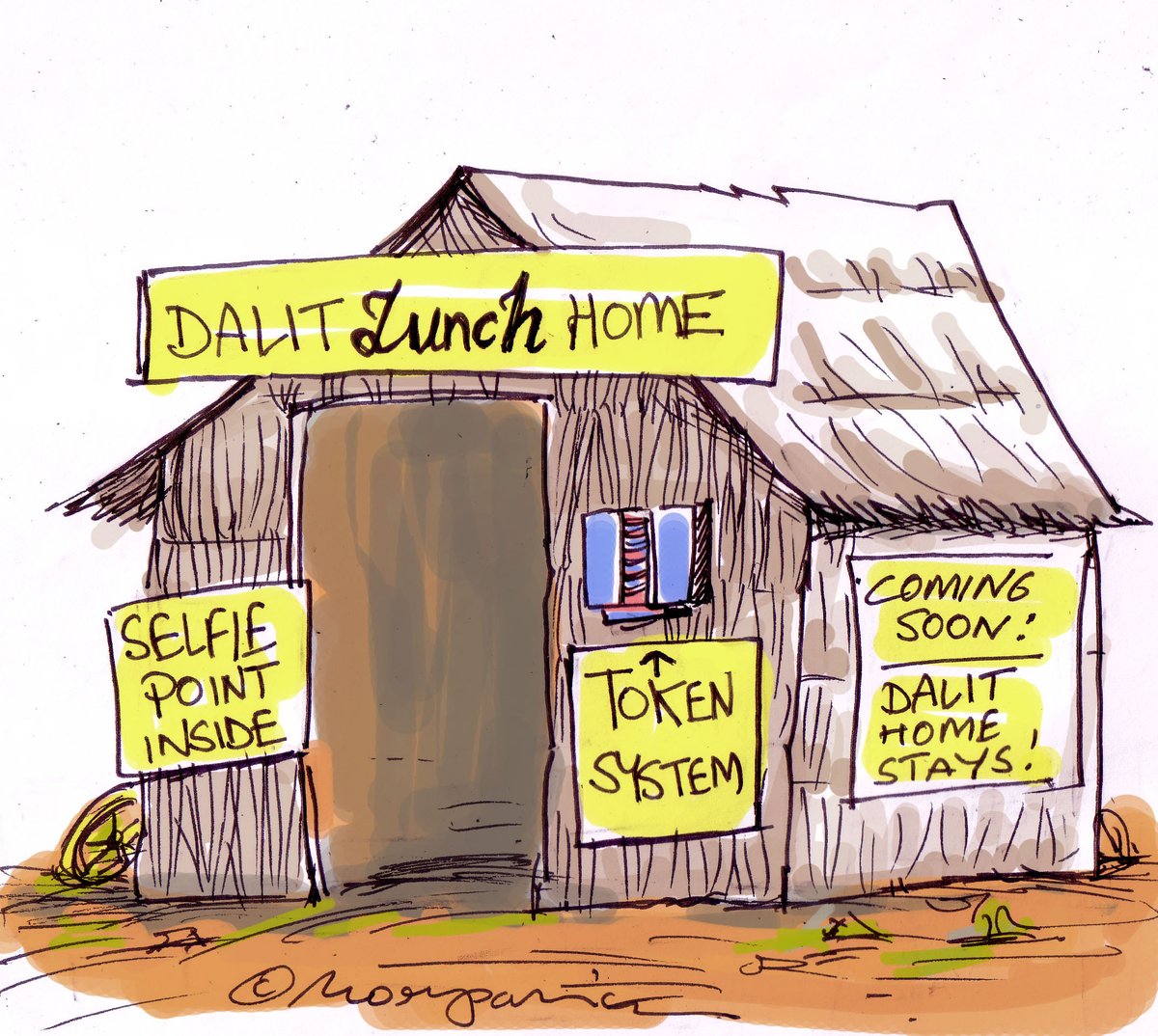
What I find more reprehensible are the accounts of apparently stage-managed dinners. There have been reports of meals at certain locations being organised from outside the Dalit vasti, although the actual consumption by the VIP took place in a Dalit home. More to the point, the visits to the Dalit habitations, whether by a Chief Minister, Minister, MP or MLA, do not often see any tangible improvement in the living conditions of local residents, partly because of the poor governance and infrastructure systems in place and more so because of the lack of opportunities for benefiting from economic growth processes.

That such publicised dinner visits reek of symbolism is one of the unfortunate spinoffs of such exercises, captured beautifully by the inimitable Hemant Morparia in a recent cartoon.

While there are many sincere politicians at different levels, there is no denying that, in the race for one upmanship that politics, in India and elsewhere, has descended to, photo opportunities are used to advance ones’ reputation in the eyes of those who matter, especially in these days of Twitter, Facebook and WhatsApp. It would be extremely heartening if the visit by a Minister / MP / MLA was followed up with intensive efforts to address the shortcomings in delivery of public services that were observed during the visit. Unfortunately, such visits tend to be one-off instances, restricted to mentions in the press and reports to political superiors on one’s efforts, spectacle rather than substance.

The other issue of concern is the widening gulf between the elected representatives and their electorate. Sighting an MP/MLA in the constituency between two elections is akin to spotting a black swan. Why, even getting to see the local corporator on the streets is a rarer occurrence than seeing a blue moon. MPs/MLAs, many of whom do not even regularly stay in the constituencies that elected them, have no system of judging the extent to which they are meeting the specific requests of their constituents (with honourable exceptions like Shashi Tharoor and Jay Panda). The result is a growing disillusionment and cynicism in the electorate, which looks to extract short-term benefits near election time, a dangerous trend in a democracy.

Having reached the ranks of the senior citizenry some time back, I feel entitled to offer my two bits of advice to MPs and MLAs.  Firstly, do try to leave your constituency looking somewhat better than when you first got elected. Insist on certain standards of efficient public service delivery, especially in the areas of health care, education and food security. It is saddening to see the ramshackle state of the public health services, ICDS and public distribution systems in constituencies that have been the pocket boroughs of particular individuals or families for years on end. Use technology to monitor processes and outcomes and develop a cadre of local youth who can facilitate the reach of basic services to the public, particularly the poor and disadvantaged.

Secondly, please use your term(s) in elected office to meaningfully contribute to the passage of effective laws that improve the economic and social conditions of your fellow citizens. This will require less of rushing to the well of the legislature and disrupting business to drive home some inane political agenda. Let me assure you that the public is heartily sick of these shenanigans and, at the first availability of a suitable substitute, will boot you out of office.

Thirdly, make it a habit to spend at least two or three days a week travelling to every area of your constituency. You have over 1800 days in office, enough to cover most villages and towns in your area. Drop in unannounced into homes, preferably in the late evenings, when you can meet with families and groups and share their joys and sorrows, as well as understand their grievances. Forget the meals, sharing a cup of tea, where you pour half the sweet concoction from the cup into a saucer and offer the latter to your host, will create a bond between you. Will this guarantee your reelection? Sadly not, elections are won and lost on a host of other considerations — religion, caste, emotions and money power. But you will have the enduring satisfaction of having participated in the lives of your less fortunate fellow women and men, giving them the strength to live another day, month and year to fight the ongoing battles of their lives.


Delhi-rium on the Delhi-gation of Powers

Since my recent Facebook post (shared also on the IAS Association page) has stirred a hornet’s nest, with retired and serving civil servants as well as concerned citizens voicing their opinions, I am constrained to bring out this blog on the AAP vs. AP episode (for the uninitiated, AAP refers to the Aam Aadmi Party, currently governing Delhi and AP refers to Anshu Prakash, a member of my erstwhile service and currently at the centre of a tornado for which he is in no way responsible). The facts have been aired ad nauseam on print, electronic and social media, but they bear repetition because so many of the principal actors have given their own versions or sidestepped the fundamental issue altogether.

A Chief Secretary (CS), the highest civilian functionary on the bureaucratic side of the state government, attends a meeting called by the Chief Minister (CM) at midnight. The subject of the meeting is shrouded in doubt — while the CS has mentioned in his police complaint that the discussion was regarding the release of TV advertisements on the completion of three years in office of the AAP government, the AAP has, through a written statement and through the mouth of its Deputy CM, claimed that the meeting was about the non-release of food rations because of faulty implementation of the Aadhaar scheme. Aspersions are being cast on the contention of the CS that he was assaulted by two persons in the presence of the CM and Deputy CM. Even the written complaint of the CS to the police, the record of his medical examination the next morning and the statement before a magistrate by the CM’s Adviser are being discounted, though these are now the subject of police investigations.

In my Facebook post, I had raised certain fundamental questions, none of which have been answered to this day. Calling the CS alone for a meeting, which took place at midnight, without summoning the concerned departmental secretaries, with some (apparently) MLAs present, on a subject that did not require overnight resolution, is itself enough to raise eyebrows. The studied silence of the head of the government on a complaint of assault (in his presence) of his senior most civil servant, is even more perplexing. But what takes the cake is the blasé attempt to pretend nothing ever happened, even after all the documentary evidence that is now in the public domain. And now, we have an article in a leading national daily by a leading AAP spokesperson (Ashish Khetan: Indian Express, 24 February 2018) which is a litany of complaints about the asymmetric division of powers between the Governments of India and Delhi.

The Government of National Capital Territory of Delhi Act of India, 1991 (NCT Act) has inter alia laid down the procedure for elections to the Legislative Assembly and specified the duties and responsibilities of the Lieutenant Governor and Ministers (including the Chief Minister). It is clear that there is an ocean of difference between the provisions governing the functioning of the Delhi government and those relating to any other state government in India. Public order, police, land and services are subjects not under the control of the Delhi Government. This has been the ground-level position ever since elected governments came to power in Delhi since 1993. But even when the parties in power in the Delhi government and at the national level were of different political persuasions, business was conducted smoothly between the two governments and little friction was evident. The situation changed after the 2015 Delhi Assembly elections, when the BJP was steamrollered by the AAP, which came to power with a staggering majority.

It is obvious to anyone that there is no love lost between these two parties. But, unfortunately, the mutual acrimony has poisoned the very functioning of democratic governance in Delhi. “Give and take” has been replaced by “thrust and parry”, with the odds heavily loaded in favour of the central government. Gone are the days when a Congress CM could informally obtain her choice as CS from even the NDA government. The collateral fallout has been the grinding of the bureaucracy between the BJP and AAP wheels. But what has been most unfortunate has been the conviction in the AAP that civil servants deputed to the Delhi government are Greeks in Trojan Horses fulfilling the agenda of the central government and are hell-bent on sabotaging the honest efforts of the state government to improve the lot of its people (and thereby improve future re-election prospects). This has led to the current impasse, where the fourth CS seems to be on his way out within a span of three years.

Civil servants are bound to serve the government of the day, whatever its political hue. During my service days in Maharashtra, we moved seamlessly between BJP-Shiv Sena and Congress-NCP governments, with not even a ripple in the bureaucracy as the reins of power were handed over from one to the other. Colleagues from other states with more combative political formations were surprised that the Maharashtra CS and senior officers were not disturbed even after the transfer of power. At the end of the day, since the permanent bureaucracy (whether All-India or state services) are recruited through open competition, the only scope for politicians lies in juggling officers around.

What did occasion surprise was the volatile reaction across wide sections of the Delhi civil services to the incident involving the Delhi CS. It seems to indicate a simmering resentment about the way the bureaucracy has been perceived (and treated) by the political executive over the past three years. Anti-corruption pogroms reminiscent of the French Reign of Terror are great for popular consumption, but, when not accompanied by systemic reforms, occasion insecurity in the civil service. This angry response from the Delhi bureaucracy should serve as a warning signal to the AAP leadership. You may have an astounding mandate from the people and be riding the wave of public popularity, but governance ultimately has to be through the permanent bureaucracy. Appointment of any number of party commissars and Parliamentary Secretaries can never substitute for the cutting edge that services the aam aurat/aadmi. Debasing the value of the civil service and treating them with contempt will lower the motivation and morale of even the honest, sincere workers (of whom there are many) and lead to a fall in the quality of public service delivery.

Of course, there are issues that need to taken up with the central government and the judiciary, when the state government feels its legitimate powers are being whittled down or that not enough powers have been vested in the state government to enable it to carry out its duties and responsibilities. There are democratic avenues for resolving such matters, including, finally, the court of the people, which assembles once every five years to give its verdict. Good work will be recognised and (hopefully) rewarded at the appropriate time. But frustration with legal shackles should not be vented on the bureaucratic whipping boy (and, increasingly, girl). As AAP seeks to widen its all-India reach, it would be salutary to remember that Delhi is not Bharat and that solutions have always to be sought within the constitutional framework.


The Twenty-first Century Animal Farm

The creatures outside looked from pig to man, and from man to pig, and from pig to man again; but already it was impossible to say which was which.” (George Orwell: Animal Farm)

कुछ तो ख़ासियत है इस प्रजातंत्र मे
वोट देता हूँ फकीरों को कंबख्त शहंशाह बन जाते हैं

(There is something special about this republic;

I vote for ascetics, the wretched fellows become emperors)

(Source: unknown)

December 2017 was a milestone in Indian jurisprudence. Three CBI courts, two in Delhi and one in Ranchi, delivered judgments in corruption cases that have exercised the public mind over the past many years. The verdicts were a mixed bag: while former bureaucrats were indicted in two of the cases, politicians got away fully in one case and partially in another case. The fodder scam related to a straightforward loot of the government treasury while the coal and 2G spectrum scams involved the questionable use of discretion at the highest levels of government in the allocation of natural resources, one below the ground and the other in the air. That discretion is still alive and kicking in the government is confirmed by the replies to a recent RTI query that stated that two successive Ministers of the Human Resource Development Ministry of the Government of India have, in the past three years, recommended, as against their annual quota of 450 cases, over 35,000 cases of students for admission to Kendriya Vidyalayas, of which nearly 20,000 have actually got admission.

Which begs the question: are governments, even those which swear by eradication of corruption, really different from one another? An answer to this is sought to be given by a book The Dictator’s Handbook: Why Bad Behavior is Almost Always Good Politics. The authors, Bruce Bueno de Mesquita and Alastair Smith, have, based on years of research and field studies, concluded that leaders are only concerned about power: concepts like “national interest” and “welfare of the people” are relevant to them only insofar as they promote the perpetuation of their power. It is irrelevant whether the leaders are despots or democrats — what preoccupies them ultimately is how to secure power and, having occupied the hot seat, how to stay on there for as long as possible.

In this quest for power, three groups are relevant to the politician. These are the interchangeables, the influentials and the essentials. The interchangeables are those who choose their governments: in the case of India, the entire population above the age of eighteen. In the “first past the post principle” that governs Indian elections, it is enough if, say, in a three-cornered contest where 60% of the electorate votes, the winning candidate secures 21% of the vote. The size of the interchangeables that determines the outcome of the election is then barely a fifth of the voting population.

Given the social cleavages in India along ethnic and religious lines (more pronounced in rural areas and small towns), a candidate from a dominant ethnic or religious group needs to marshal the support of her group to emerge victorious at the hustings. It is here that the influentials matter: composed of those who can control “vote banks” through use of money and muscle power as well as through their command over ethnic-based patronage structures.

But, in the final analysis, the ability of the leader to acquire and retain power depends on her essentials, those in her inner circle who have access to funds and control the party bureaucracy. These essentials are a necessary evil: they help propel the leader to the top, but the leader is always uneasily aware that many among them harbour ambitions of replacing her.

The Indian political scene over the past seventy years has seen the evolution of three distinct cultures, two of which have risen and ebbed with the passage of time, while the third one is presently at its apogee. The first was the Congress culture, which was virtually unchallenged till 1967 but thereafter faced challenges from regional formations till its upset in the 1990s followed (after a ten-year second honeymoon) by its greatest electoral disaster in India’s electoral history. This culture relied on powerful caste leaders marshalling votes of their fellow caste-persons for the Congress, aided by the use of muscle and money. Post-1975, the leader always centralised power in a small coterie of essentials, with leadership of state governments and state party units being decided by the High Command, essentially composed of the leader and her trusted lieutenants. For unhesitatingly accepting the suzerainty of the leader, the state satraps (and their Delhi counterparts) were allowed to exercise patronage in a variety of government functions – procurement contracts, allocation of scarce resources (including even government housing) and postings and transfers of government servants. Post-1991, the patronage also extended to the allocation of natural resources, as the opening up of the economy led to the drying up of some traditional sources of patronage. Of course, an eagle eye was kept on all these functionaries to ensure that they delivered an adequate share of the unearned economic rent to the top, apart from checking any efforts to assert independence from the High Command.

As the middle castes started asserting their right to a share of the economic and political pie, the subaltern culture developed from the 1970s onwards, slowly at first and, with the ossification of the Congress, more pronouncedly from the 1980s onwards. More and more states spun away from the Congress universe, through the coming to power of regional parties, mostly with pronounced family and caste ties. These parties also relied on the same formula of interchangeables-influentials-essentials. Inner-party democracy was a joke and the leader cult was propagated with renewed vigour right across India, from Kashmir to Kanyakumari and from Dibang to Dwaraka. The composition of interchangeables changed with the formation of new caste and religious alliances, with the promise of Utopia to groups which had suffered from disastrous governance and lack of access to basic human facilities. But the leader and her essentials still governed with the support of influentials. These influentials were virtually allotted jagirs which they could exploit like the zamindars of yore. The bahubali (strongman) phenomenon was aided by weak state capacity in public service delivery and the virtual absence of the rule of law. While the leader and her essentials milked the state coffers, the influentials resorted to extortion, kidnapping and murder to enforce their writ and extract economic rent.

We are now in the Treta Yuga of the BJP-Hindutva culture, epitomised by a strong leader and a fully subservient party structure. Retail corruption at the central level appears to have been phased out, though the same cannot necessarily be said for states under the control of the party. The power of the essentials at the centre has been curbed, at least for the time being, with decision-making centralised in the Prime Minister’s Office. Influentials have been accommodated with MP posts or with institutional sinecures. At lower levels of the district and small towns, influentials have been given latitude to demonise minority communities, employing the icons of pseudo-patriotism, the cow and women’s honour. This, it is hoped, will keep alive the influentials’ enthusiasm to mobilise the interchangeables to support a specific sectarian ideology.

With every new political party adopting one or more (or a mix) of the three cultures enumerated above, it is difficult to be optimistic about a new socio-political culture developing in the country. This is why, despite so much heat and light being generated on essential political and administrative reforms, my prognosis remains that:

  • effective Lokpal and Lokayukta systems will never see the light of day;
  • reforms in electoral funding will be half-hearted and opaque, designed to serve the interests of self-perpetuating politicians. In any case, corruption in the public space is related to basic human greed and not just high costs of contesting elections;
  • political functionaries will never give up their basic right to patronage, be it in procurement, transfers or resource allocation: the variation will only be in whether such discretion is exercised at a wholesale or retail level;
  • administrative (including police) reforms will receive only lip service since no political formation in India wishes to forego its royal prerogative to manipulate the official machinery to meet its partisan ends. The CBI (and also other investigative agencies like the Directorate of Revenue Intelligence and the Income Tax Department) will continue to be used to inconvenience political opponents and those with differing political views;
  • judicial reforms, especially in the criminal justice sphere, will be halting and piecemeal. No political outfit wishes to expose its essentials and influentials to rigorous scrutiny of the law and mutual back-scratching will allow “business as usual” to continue unchecked.

What does all this imply for the future of the inhabitants of India’s Animal Farm? The politician will continue her operations as always, untroubled by public opinion or by that inner voice that lesser mortals call “conscience”. The ordinary citizen will continue to trudge her way to the polling booth every five years, giving another chance to the incumbent or garlanding a new suitor in the fond hope that her lot will improve. And what of my former tribe of civil servants? They would be well-advised not to follow in the footsteps of Boxer, the faithful workhorse of Orwell’s Animal Farm, who was despatched to the slaughter-house as a reward for his unremitting and honest toil on the farm.

Of bullshit…and suchlike matters

A recent article in the Hindu interested me deeply. The author dealt with the complete disinterest in facts in our time, especially among leading political figures. Of special interest to me was his reference to the 1986 essay of the American philosopher Harry Frankfurt. Titled “On Bullshit”, the essay distinguishes between lying and bullshitting. The liar is aware that what he is seeking to convey is false, that the listener will be led away “from a correct apprehension of reality”. Thus, Yudhishthira, during the Mahabharata war, had to utter the fateful words “Ashwatthama is dead” to destroy Dronacharya’s will to fight (indeed to live), though he added thereafter, inaudible to Drona, “Narova kunjarova” (I am not sure whether it is man or elephant). He was throughout fully aware that his lie was the trigger for an event that would influence the outcome of the war. The bullshitter, on the contrary, is unconcerned with the truth or the facts as they actually are; as Frankfurt puts it “his intention is neither to report the truth nor to conceal it.”

Bullshitting is probably reaching an all-time high now, far higher than estimated by Frankfurt in 1986. Those of us in the civil services were quite familiar with this syndrome. As the year-end neared, the boss would question us district officers about achievement of targets in different government programmes, whether of sterilisation cases, small savings or hut construction. It was stupefying to see officer after officer confidently affirm that he/she would achieve the annual targets, never mind that the achievement after nine months of the year was not even remotely close to the 75% mark. But these replies satisfied the boss; he probably displayed the same sang froid when attending the Chief Secretary’s review meeting.

Bullshitting can, however, enter into far more dangerous, uncharted terrain when it becomes the social norm. The spread of mass media, especially the electronic media, has intensified this disease. With 24*7 studio appearances, there is an almost unlimited demand for “experts” who can hold forth on any topic under the sun, with each news channel having its own mafia of experts, never mind that they have very little hands-on experience of the subject matter. Public memory of these half-hour sessions is short and, unlike the print media, where opinions are sealed in black and white on paper, a commentator can offer contrary views the next week, without anyone remembering what he said the week before. Equity analysts are beneficiaries of this system: they can advocate investing in a particular stock on a particular day, without accountability to all those poor sods who lose their life savings in some unwise investment recommended by the analyst. But seasoned political commentators are no exception to the rule. During the last Bihar assembly elections, I remember the chief anchor of a prominent news channel and a very well-known political commentator predicting the victory of the Bharatiya Janata Party at 9 in the morning, based on the leads available till then. Now, as any seasoned administrator can tell you, by 9 AM, postal votes have just about been counted. These are a miniscule fraction of the total votes polled and largely represent the votes of servicemen and election staff on duty. Needless to say, there were red faces all around in the studio and abject apologies from the experts when, a couple of hours later, the trends showed a clear victory for the Janata Dal (United)-Rashtriya Janata Dal coalition.

Things have become worse with the rapid advent of social media in the past few years. Now, every Tukaram, Damodar and Hari is an expert who can weigh in on a range of topics from pollution in Delhi to Rohit Sharma’s loss of form and the prospects of the AIADMK in the next general elections. Twitter and WhatsApp sites are flooded with opinions, often ill-formed and downright vicious, accompanied by a flood of invective designed to cow the opposition. A recent, appalling forward on WhatsApp asks Hindus to unite, else the Muslim population will overtake the Hindu population in India in the next two decades. Ignoring the official statistics that show the Muslim population in India grew from 9.8% of the population in 1951 to 14.2% in 2011, the message estimates increases in the percentage of Muslim population to 38.1% in 2031 and 84.5% in 2041. That such a possibility is neither mathematically nor humanly possible seems to have escaped the attention of the bullshitters spreading these canards.

It is in this context that thinking people in India, who value the principles that have held this country together for the last seventy years, are concerned about the rapidly falling standards of public discourse, including the jettisoning of truth, especially during election campaigns. There have been regrettable attempts at community profiling and portraying opponents as “anti-national”. These efforts seem to have reached their zenith in recent days in the run up to the Gujarat state elections. For the first time, a serving Prime Minister has cast aspersions on the patriotism of not only a former Prime Minister and Vice President but also of retired civil and military officials. A normal dinner meeting with a former dignitary from Pakistan has been labelled a “secret meeting”. The reference in an unverified tweet to the preference of a retired army officer from across the border for a Chief Minister from a particular community has been made the basis for inferring interference in the election process.

What is unfortunate is that all these statements over the past four years lead one to infer that loose, unrelated conclusions are drawn on the basis of unsubstantiated information and dubious statistics. The consequences can be hazardous for the country on two counts. First, it panders to the deep insecurities that people already nurture within themselves and poisons the social environment. We just need to reflect on the recent brutal murder in Rajsamand, Rajasthan to understand how deep this sickness has taken root in the Indian (Hindu) ethos. The second consequence has a historical precedent. In 1962, the country was led to military defeat by the bullshit doled out to an impressionable Prime Minister and Defence Minister by a Corps Commander with overweening confidence. Failure to pay attention to truth at the top echelons of government will inevitably lead to bullshitting at lower levels, with disastrous results in various sectors of governance. The wise old adage “Yatha raja tatha praja” (as is the ruler, so are the ruled) continues to have relevance even today.

This article was originally published on Indus Dictum, a site where thought leaders from diverse fields, spanning business and technology to politics and modern law, contribute unique insights and experiences. You can access the article here

The Lutyens’ Class Wars

Ever since the time of the Mahabharata, the area around Lutyens’ Delhi has been the epicentre of intra-class warfare. What began with the Kauravas and Pandavas has wound its way through the dreary course of the Sultanate and Mughal periods (soon to be erased from historical memory if the present dispensation has its way) down to their present-day successors in the Dilli Durbar. The similarity hit me strongly as I witnessed the verbal fisticuffs in the national electronic media over everything from demonetisation to Kashmir, triple talaq and the recent murder of a journalist. To be fair to the media, the class war in the City of Djinns has a schism running far deeper down into society, which provides an interesting sociological analysis of our lives and times over the past seventy years of our raucous democracy.

As a latter-day renegade from the Lutyens’ class, I must confess my ties to this class over a period of a quarter century, a score of them as a student in school and college and five more years as a sarkari factotum. The Lutyens’ class can be categorised into two groups — the first, the Lutyens’ Class of 1947 (LC-47) dominating the first half century after independence and the second, the Lutyens’ Class of 1992 (LC-92) developing its strength gradually but surely after the Babri Masjid demolition in 1992.

LC-47 comprises segments of those who were educated in the schools and colleges of Delhi and imbibed the liberal political philosophy of the Nehruvian era. The economic philosophy of LC-47 adherents generally started off left of centre, with a distinguishing characteristic being their secure belief in the socialist state and its “benevolent” guiding hand. Patronised extensively by the ruling elite, which needed the LC-47 intellectuals to validate their “progressive” credentials, the LC-47 occupied the commanding heights of the bureaucracy and academia, commerce being left to the vulgar business class. They were equally at home in the rarefied environs of the India International Centre and the more plebeian atmosphere of university coffee houses. 1989-1991 dealt the first blow to this insulated existence, with the fall of the Berlin Wall and the collapse of the Soviet Bloc putting a virtual end to their leftist pretensions. The economic liberalisation post-1991 and the growing opportunities for academic tenures and private employment in the West saw many LC-47 members veer sharply to the right in their economic worldview, although their faith in the pluralism and inclusiveness of the post-independence Indian polity remained undimmed.

The tumultuous years of the Mandal-Mandir imbroglio culminating in the demolition of the Babri Masjid spelt the final demise of the Nehruvian consensus on economic, social and political issues, with the end of largely one-party rule at the centre and single party hegemony in the states. LC-47 now faced the emergence of the fledgling LC-92, the latter having a marked preference for an ideology that stressed the supremacy of the majority religion, highlighted its past glories and lamented the “short-sighted” minority-oriented policies that had apparently, over the past fifty years, impaired the full flowering of majoritarian-based nationhood.

As the Grand Old Party of India’s independence withered, the Indian people started experimenting with political alternatives. The electoral successes of the Bharatiya Janata Party (BJP) at the national level and in various states around the turn of the century boosted the fortunes of LC-92. However, their joy was short-lived as India Shining suddenly came a cropper in 2004. The UPA interregnum was put to good use by LC-92 in developing its ideology and putting together a cadre of “intellectuals” who could spread their message to the middle class and prepare for the day when the political formation they supported came to power. Ten years of vanvas later, LC-92 came into its own with the electoral victory of 2014.

The last three years have seen the systematic infiltration of the LC-92 into the hitherto impregnable bastions of the left-liberal LC-47. Physical and social science bodies and academic institutions have been taken over, academic curricula are being reshaped and student conformity is stressed as the desirable norm. More importantly, public platforms (symposia, seminars, etc.) are now abundantly available for dissemination of the new weltanschauung. Media channels, where they have not been completely subordinated to the LC-92 viewpoint, are voluntarily incorporating liberal doses of LC-92 sermonising. It could well be argued that the boot is now on the other foot: after years of monopolizing the print media and the air waves, LC-47 is now making way for its right-conservative successor, LC-92. Of course, where social media is concerned, LC-92 is the hands-down winner, having used it in a successful election campaign and building a cadre of “no holds barred” followers who are ready to tarnish any reputation.

LC-47 has, over the years, made its own Faustian compromises. It swore by socialism even as favoured private companies tapped into the economic rent. It settled for the “Hindu” rate of growth, overlooking important drivers of growth like primary education and public health, which drove the growth story in the country’s East Asian contemporaries. Above all, it countenanced the development of a highly venal political and bureaucratic class, a natural outcome of the “inspector-license-permit” Raj. Its commitment to genuinely democratic values was also suspect, whether in supporting the Emergency, tolerating the anti-Sikh pogroms of its political patrons or ignoring the major warts in a highly undemocratic, inefficient ruling regime in West Bengal. Nor can one forget the glowing encomiums paid by leading LC-47 intellectuals to highly oppressive, totalitarian regimes in the Soviet Union and the People’s Republic of China, responsible for genocides that outdid the Nazi excesses. It is truly reflective of the irony of our times that the self-same LC-47 intelligentsia point fingers at the supposed lack of adherence to democratic values of the formations supported ideologically by LC-92 acolytes.

What is most intriguing is the narrow gap between the economic worldviews of the two warring clans. Both are, at heart, votaries of big government, though ostensibly for different reasons. LC-47 is convinced that government must have its fingers (all ten of them) in the economic pie to usher in the utopia of equality. Evidence to the contrary is stubbornly rejected: monstrous, inefficient public-sector enterprises, an exploitative, rent-seeking bureaucracy and the failure of India on most social sector fronts. The obsession with planning and the planned economy led, since the mid-1950s, to the downgrading, if not elimination, of almost all economic philosophy that sought to promote the market in at least certain activities and certain sectors: Mahalanobis all but banished Brahmananda from economics textbooks.

But anyone who labours under the illusion that LC-92 comprises free market enthusiasts is in for a rude shock. The economic outlook of this class is probably closer to the tenets of National Socialism rather than unabashed capitalism. LC-92 followers are admirers of a strong, masculine state in both the economic and political spheres. The state is expected to have a political philosophy that emphasizes national pride, projected through the prisms of a glorious past, military might and specific symbols of national identity, like religion, customs and traditions. The economic approach relies on a close synergy between the state and corporate interests, on the lines of the Prussian-German model of the nineteenth century and the first few decades of the twentieth century.

What truly links the LC-47 and LC-92 schools is the irrelevance of their outpourings to the mass of the people of India. Controversies over playing of national anthems in cinema halls, rewriting of history books and the merits and demerits of demonetisation leave the aam aurat/aadmi out of their calculations altogether. The Lutyens’ Class of either vintage has not engaged in issues which constitute life and death for the common man, be they unemployment, unviable farming, substandard schooling and health systems or the difficulties in starting and doing honest business in India. As one observes the political class, the bureaucracy, the media and academia lodged in and around Lutyens’ Delhi, one is struck by the lack of imagination and commitment in coming up with truly innovative solutions to meet the aspirations of India’s millions. It is almost as if they are forever engaged in Herman Hesse’s Glass Bead Game, theoretical exercises in policy making that take no account of the realities of India.

This article was originally published on Indus Dictum, a site where thought leaders from diverse fields, spanning business and technology to politics and modern law, contribute unique insights and experiences. You can access the article here.


Rushing In Where Angels Fear To Tread

News reports stated that an eleven years old girl from Simdega district in Jharkhand died apparently because her family could not get their food grain entitlement as their ration card was not Aadhaar-linked. I say “apparently” because, in this post-truth age, one never knows how to separate fact and fiction in media reports. There will also be the usual controversy over whether health or nutrition factors were primarily responsible for her mortality, with all commentators blissfully unaware of the close linkages between the two. But, knowing how things work in India that is Bharat, I am certain that the failure to link their Aadhaar numbers to their ration cards must have cost many families access to subsidised food grains. This view is bolstered by reports that seem to confirm that the ration card of the family in question was not linked to the Aadhaar card.

I am not going into the merits of Aadhaar linkage to beneficiary schemes, on which enough heat and sound has been generated without any light. But I am concerned about the haste in rushing in to implement policy measures without adequate backup systems. This has a lot to do with the current obsession in governments to show results immediately. In the Jharkhand case, time could have been taken to ensure that most of the population had obtained Aadhaar cards and efforts could have been made over some months to ensure Aadhaar linkage with ration cards. But the childish enthusiasm of the political and administrative executive of Jharkhand to score brownie points with the higher-ups in Delhi probably led to their claiming that they had managed almost full linkage of ration cards with Aadhaar numbers.

The same issue bedevils MGNREGA payments in Jharkhand as well, with documented evidence that the system of online bank account transfers has resulted in inordinate delays in wage payments. If you think such poorly planned policies have troubled only the really poor, think again. Major financial decisions taken over the past year have played havoc with large segments of society, not because of lack of intrinsic merit, but because of the desire to impress the public that this is a “government that works”.

Demonetisation was intended to be the sledgehammer that would eliminate black money, check counterfeit currency and improve tax compliance through reliance on digital transactions. A year down the road, even after all the travails borne by the long-suffering public, it is evident that the black money scourge refuses to die, the introduction of more and more currency notes in different denominations will be a boon to counterfeiters and that tax compliance will become a reality only when simplified tax structures are in place and when sound legal systems exist to penalise defaulters quickly and effectively. Which begs the question of whether demonetisation could not have been handled in a more graduated fashion, with new currency notes going into circulation before the withdrawal of old currency notes.

The same thought haunts one when observing the hasty digitisation of the GST. Considering that it took thirteen years for this baby to be born, the infancy phase could have been handled better. The “tryst with destiny” has certainly altered the destiny of small retailers and merchants, many of whom find the process of filing returns excessively cumbersome. In its fourth month of implementation, technical glitches still thwart the filing of returns: GSTR1 filing for July has just been completed, with filings for subsequent months pushed to November. Despite the promises of the Union Finance Minister to process refunds expeditiously, CAs are of the view that refunds could take six months or more, affecting cash flows of businesses. Gradual phasing in of GST online systems with continuation of the service tax regime for some more months would probably have ensured less transitional pain.

Ramming Aadhaar compliance down the throats of income tax payers and bank account holders will, I suspect, unleash another Pandora’s Box in the months to come. Again, I am not questioning the rationale but the speed of expected compliance, consequences be damned. Filing income tax returns for FY 2016-17 required all those not having Aadhaar cards as of April 2017 to get them by July 2017. Pensioners and the elderly were particularly inconvenienced. Linking Aadhaar numbers to bank accounts has its own technical problems. Most banks have no robust online mechanism to enable the account holder to verify that her bank account is indeed Aadhaar-linked. Come February 2018, citizens may well be faced with the nightmare (actually, it should be called daymare) of their accounts being frozen, leading them to beg on the streets. The insistence on linking mobile numbers to Aadhaar numbers, apparently mandated by the Supreme Court, is yet another nuisance around the corner.

Make haste slowly” is a salutary motto for good governance. This tendency of the civil service is viewed unfavourably by professional politicians, obsessed with the five-year election itch: why, even an ex-bureaucrat like Arvind Kejriwal has commented unfavourably on IAS officers sitting on files. Many of us were roasted by Ministers and Chief Ministers when we insisted on listing on file the pros and cons of any decision, probably a reason for at least some of us being overlooked for prize postings. Pointing out all the possible implications of a decision ensures at least that, if Plan A goes wrong, Plans B and C can be put into operation. It is the current fashion to run down the 1991 economic reforms as being rather halting and piecemeal. As one who was in Delhi at that stage, I am happy that even those reforms that did take place at that time went through, given the attachment of establishment politicians to “crony socialism” and the hostility of an established elite to the whittling down of its gravy train.

The rush to push through major decisions has, no doubt, been influenced by the relatively narrow window before the 2019 general elections. If the favourable results take time to mature, the government may well have to reap the whirlwind of short-term resentment. In the present climate of harking back to our glorious past, I take the liberty of recounting the story of Bhasmasura. Blessed by Siva with the boon of turning whatever he touched to ashes, Bhasmasura sought to test the boon on his benefactor. It took the wiles of the damsel Mohini to persuade Bhasmasura (in the hope of acquiring her) to place his hand on his own head and be turned to ashes. Governments would do well to heed this parable. Chasing the electorate (Siva) to test its powers, the government (Bhasmasura) is finally enticed by Mohini (the election process) to destroy its continuance in power through unwise, ill thought out steps. Yet again I resort, ad nauseam ad infinitum, to my favourite quote:

Those who do not remember the past are condemned to repeat it.

This article was originally published on Indus Dictum, a site where thought leaders from diverse fields, spanning business and technology to politics and modern law, contribute unique insights and experiences. You can access the article here.

The Strong Man Cometh

(*: Man refers in this article to the species homo sapiens and has no gender connotations)

Après nous le déluge(Madame de Pompadour)

Surely the Second Coming is at hand.(The Second Coming: William Butler Yeats)

“If God did not exist, it would be necessary to invent him.(Voltaire)

The apocryphal quote attributed to the mistress of Louis XV of France sums up the attitude of sections of the population to the demise (and the removal from the earth) of a strong, autocratic personality from their midst. One saw it in Uzbekistan, where one despot was replaced by another; why, even in a state like Tamil Nadu, which is part of the noisy, fractious democracy that is India, it was difficult for people to come to terms with Amma’s Anno Domini. The Pandava Yudhishthira was spot on in his reply to the Yaksha’s question “Day after day countless people die. Yet the living wish to live forever. What can be a greater wonder?” This futile desire of the masses to immortalise their icons is reflected in the conviction of those worshipped that they are destined to live, if not forever, at least into the distant future. This is possibly one of the reasons why there is no attempt at succession planning, though the fear of a far more competent successor may well weigh on the mind as well. Be that as it may, what is more worrisome is that more and more societies, especially those with a tradition of liberal democracy, are turning towards perceived “supermen” and “superwomen” to tackle the vexing problems of the twenty first century.

It is not as though there have been no dominant ruling personalities in history – just think of Henry VIII, Ivan the Terrible, Catherine the Great and Napoleon. What distinguished the despots of the twentieth century from their predecessors was the access to technology that enabled them to so totally dominate the minds and actions of their subjects. Stalin, Hitler and Mao, and an assortment of lower-scale tyrants, could impose their will on every citizen, using the reach of communication technology to create an atmosphere of unpredictable terror and herding together citizens into camps and communes (for reeducation, ethnic cleansing and indoctrination) in numbers never contemplated in earlier centuries. Superior weapons, instruments of terror and ideology-brainwashed bureaucracies eliminated millions in the name of future utopias. The inevitable end of the controlling autocrats led to the unravelling of their tyrannical systems. But Tiananmen Square and the fall of the Berlin Wall have not quite led to the expected explosion of democracy. In fact, China continues to combine a liberalised economy with a highly restrictive political system and Russia, after flirting with democracy for a few years, is headed for a one-man, one-party dictatorship for the foreseeable future. Authoritarian regimes are thriving in many countries in Asia, and Africa and Latin America swing between democracy and absolute rule.

What, however, gives greatest cause for concern is the growing tendency for citizens of liberal democracies to readily jettison the basic tenets of democracy – pluralism, tolerance, free expression – in a world where they perceive themselves as insecure, in the economic, political and social senses. It started with the Brexit vote in the United Kingdom, led to the political earthquake of last year in the USA and is now spreading slowly but surely across Italy, France, Holland and Germany (although the citizens of France have thwarted it for the time being). A figure from the right end of the political spectrum is emerging in every democracy who promises heaven on earth to his leaderless flock. So what traits characterise such men (and women) and which environments provide the best soil for their growth and entrenchment in a society? I can think of six such elements:

Megalothymia

Megalothymia is defined by Francis Fukuyama (The End of History and the Last Man) as “the desire to be recognised as superior to other people”. This desire for recognition typically aims at dominating others and bending them to one’s will. Mostly observed in the political class, but equally recognisable in corporate chieftains, top bureaucrats and orchestra conductors, this trait manifests itself in the conviction of the megalothymic person that he has a unique mission to fulfil during his tenure on earth. Fukuyama argues that even a person like Socrates stressed the need for a class of courageous and public-spirited guardians who would sacrifice their material desires and comforts for the common good. But Socrates was also clear that the megalothymic tendency needed to be curbed if the political order was to be preserved. Liberal modern democracies attempt this discipline through the existence of countervailing centres of political power and the second, third and fourth estates (the legislature, judiciary and press respectively) and what could be termed the fifth estate (viz. civil society).

Social engineering:

The unique mission of the megalothymic leader has, since the early twentieth century, taken the form of engaging with the transformation of the very structure of society. Communism and National Socialism represented ideologies that had their own visions of the future course history should take. Forced collectivisation and gulags in the Soviet Union, the solution of the Jewish question in Nazi Germany and its wartime acquisitions and the Great Leap Forward and Cultural Revolution in Communist China were efforts to direct societies in specific directions envisioned by the Great Leader, with the terrible consequences being borne by millions of people in the half century from 1925 onwards. Recent actions or intentions, like extra-judicial executions in the Philippines, demonetization in India, promoting the Islamic way of life in Turkey and the proposals of the new President of the USA to reduce immigration and restrict individual choice in personal matters like abortion and same sex marriage also bear the imprint of social engineering imposed from above.

Infallibility:

In the effort to impose his vision on society, the Leader has, always, to be steadfast in the certainty of his convictions. George Orwell’s “Big Brother” is always right. No opposition or dissent is tolerated, with likely competitors being dealt with through purges (Bukharin), assassination (Trotsky) or reeducation (Deng Xiao Ping). We can observe this trend in political life in India, both in national and state-level parties, where heresy (opposition to the Leader) is punished by banishment from the party and political exile. Democracies have this cardinal virtue: as the philosopher Karl Popper put it, governments can be replaced in a bloodless way, acting as a salutary check on the hubris and vaingloriousness of potential autocrats.

Authoritarian predisposition:

The megalothymic personality is quite likely to display authoritarian tendencies. What encourages this trait in him is the display of an authoritarian predisposition in the population he rules over. Karen Stenner (The Authoritarian Dynamic) has pointed out that, in times of perceived normative threats, this authoritarian disposition is activated and leads to support for the authoritarian who promises a return to a secure, glorious past. Support of the majority of the population is not required; it is enough if a vocal, aggressive section of the population backs the autocrat, with the rest of the population either too divided or disinterested in offering any meaningful opposition. The minority then employs extra-constitutional, vigilante methods to terrify the general population through its unpredictable responses, as Hitler’s Storm Troopers did in the early years of his rise to power.

Exclusivist ideology

The regime of the strong man requires the development of an insular approach, with the ‘other’ identified as the source of threat. Policies are tweaked to restrict the freedoms available to specific groups, related to association, livelihood, movement and expression. Media outlets are encouraged to spread an atmosphere of fear and insecurity. The results are already visible in the world’s two largest democracies, where vigilante groups and individuals are dispensing “street justice” to the victims of their ire, innocent citizens who are merely going about their daily lives.

Institutional capture

Institutional capture begins with the electoral process. Adverse domestic economic conditions, an insecure external environment, joblessness, inflation and (increasingly in many countries) a harkening back to past glories, religious dogma and perceived historical injustices bring electoral majorities to the strong man. With the legislature under control, other institutions are subtly subverted. The media, which is already overwhelmingly under business control, is slowly moulded to conform to the vision of the strong man and to hail the utopia he is bringing about. Packing the senior judiciary with persons whose ideological stances mirror those of the ruling dispensation enables dilution of the one check on executive power. The civil service is kept in line through side-lining independent professionals and promoting those committed to the ruling ideology. Above all, the control over pedagogic content is ensured through staffing educational institutions with loyal apparatchiks and rewriting history to mould the minds of the coming generation to accept a worldview vastly different from that of their preceding generation.

The emergence of the strong man in society after society comes at a time when liberal democracies are coming under increasing threat. Those who have benefited economically and socially from the efforts of past governments readily run down the achievements of these previous governments and place the blame for all ills on the inertia and corruption of the past. With a largely technocratic approach to life, and discounting the liberalism and pluralism that have been the fundamental bedrocks of prosperity, the citizens of the “Brave New World” yearn for certainty and security, forgetting that it is they who have the power to make or unmake their future. In this environment of disenchantment and hopelessness steps in the strong man fulfilling the dire prediction of Yeats “And what rough beast, its hour come round at last, slouches towards Bethlehem to be born?”